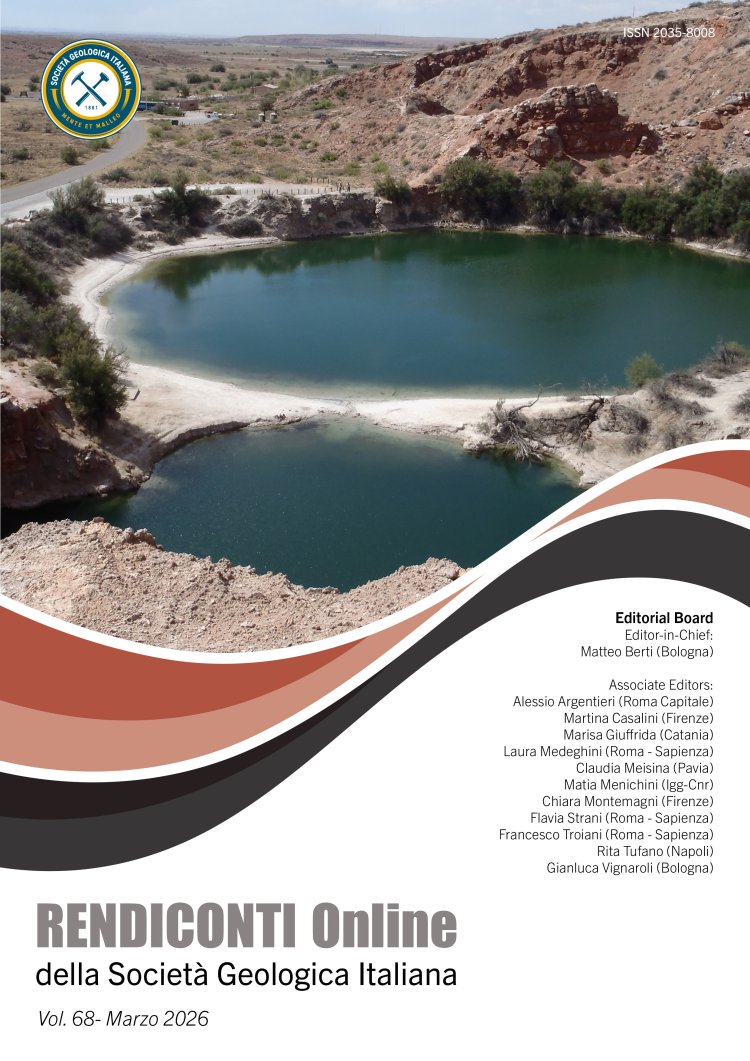
Quinis: a small hamlet in the Tagliamento valley (NE Italy), an example of resilience to sinkhole geohazard
Iqra Yaqoob1, Alice Busetti1, Marco Possamai1,2, Luca Zini1, Emanuele Forte1 & Chiara Calligaris1
1University of Trieste, Department of Mathematics, Informatics and Geosciences, Via Weiss 2, 34128, Trieste, Italy.
2Esplora srl, Via Giglio Padovan 10, 34138, Trieste, Italy.
Corresponding author e-mail: abusetti@units.it
Volume: 68/2026
Pages: 27-33
Abstract
A sinkhole is a naturally formed depression typical of the karst landscapes. Our research focuses on the North-Western mountainous sector of Friuli Venezia Giulia (FVG) region in the NE of Italy, specifically in the Tagliamento Valley within the Enemonzo municipality, in the hamlet of Quinis. The study site, known since the sixties for the presence of geohazards linked to the occurrence of huge collapses, is placed upon loose deposits interdigitated with the fluvial terraces of the Tagliamento River, mantling an evaporitic Upper Triassic (Carnian) bedrock. Over time, this type of bedrock has favoured the development of subsidence features such as cover collapse and suffosion sinkholes.
In this framework, the researchers of Trieste University jointly with the functionaries of the Geological survey of the FVG Region, have tried to focus on better understanding this type of geohazard in order to make possible the coexistence among inhabitants, man-made structures and the natural evolution of the area.
Since 2009 different type of investigations including geological and geomorphological surveys, trenches and drilling, as well as indirect surveys using PS-InSAR technology and geophysical methods such as Electrical Resistivity Tomography (ERT), Reflection (REFL) and Refraction (REFR) seismics, 2D and 3D Ground Penetrating Radar (GPR), and in some specific contexts frequency domain Electro-magnetometry (FDEM) have been used.
The integrated approach has enhanced the understanding of the area; however, no practical solutions are currently available to significantly mitigate the geohazard. In this paper, we focus on satellite interferometry and 3D GPR investigations, to outline and define the state of activity of the sinkhole phenomena in the Quinis area.
Keywords
Get Full Text